
Door Bars, Thresholds and Grippers Explained
The small parts that hold a floor down and finish its edges: what gripper does, why the join belongs under the door, and which bar suits which pair of floors.
Gripper holds a carpet taut around the edges of a room, and a door bar covers the join where one floor meets another in a doorway. They are small, cheap parts, and they decide how finished a floor looks more than almost anything else.
They are also where most of the questions come from once a quote lands, so it is worth knowing what each one is for.
What Carpet Gripper Does
Gripper is a thin strip of wood set with angled pins, fixed around the perimeter of the room a short distance from the skirting. The carpet is stretched over it and the pins hold it under tension.
That tension is the whole point. A carpet that is stretched properly stays flat for years; one that is merely laid will ripple, and those ripples become wear lines because every footfall lands on the same raised edge.
Why the Join Sits Under the Door
Where two floors meet, the change belongs directly beneath the closed door. With the door shut, each room shows a single unbroken floor, and the join is simply not visible from either side.
A join out in the opening, or worse still a few inches into one room, draws the eye every time anyone walks through. It is the same amount of work to get it right.
Types of Door Bar
Bars come in different profiles for different jobs, usually in metal, and in a range of finishes so they can be matched to the door furniture rather than fought with.
- Carpet to carpet: a double sided bar that grips both sides
- Carpet to hard floor: a profile with a lip that holds the carpet edge and sits over the hard floor
- Hard floor to hard floor: a flat cover strip spanning the gap between the two
- Ramp or reducer: for a noticeable difference in height between the two floors
Thresholds Between Different Heights
Two floors are rarely the same thickness, and a step of even a few millimetres in a doorway is a trip hazard as well as an eyesore. A ramped threshold takes the level down gradually instead.
Where the difference is larger, it is usually better to deal with it in the subfloor before fitting than to cover it with an increasingly chunky bar.
Expansion Gaps, Skirting and Beading
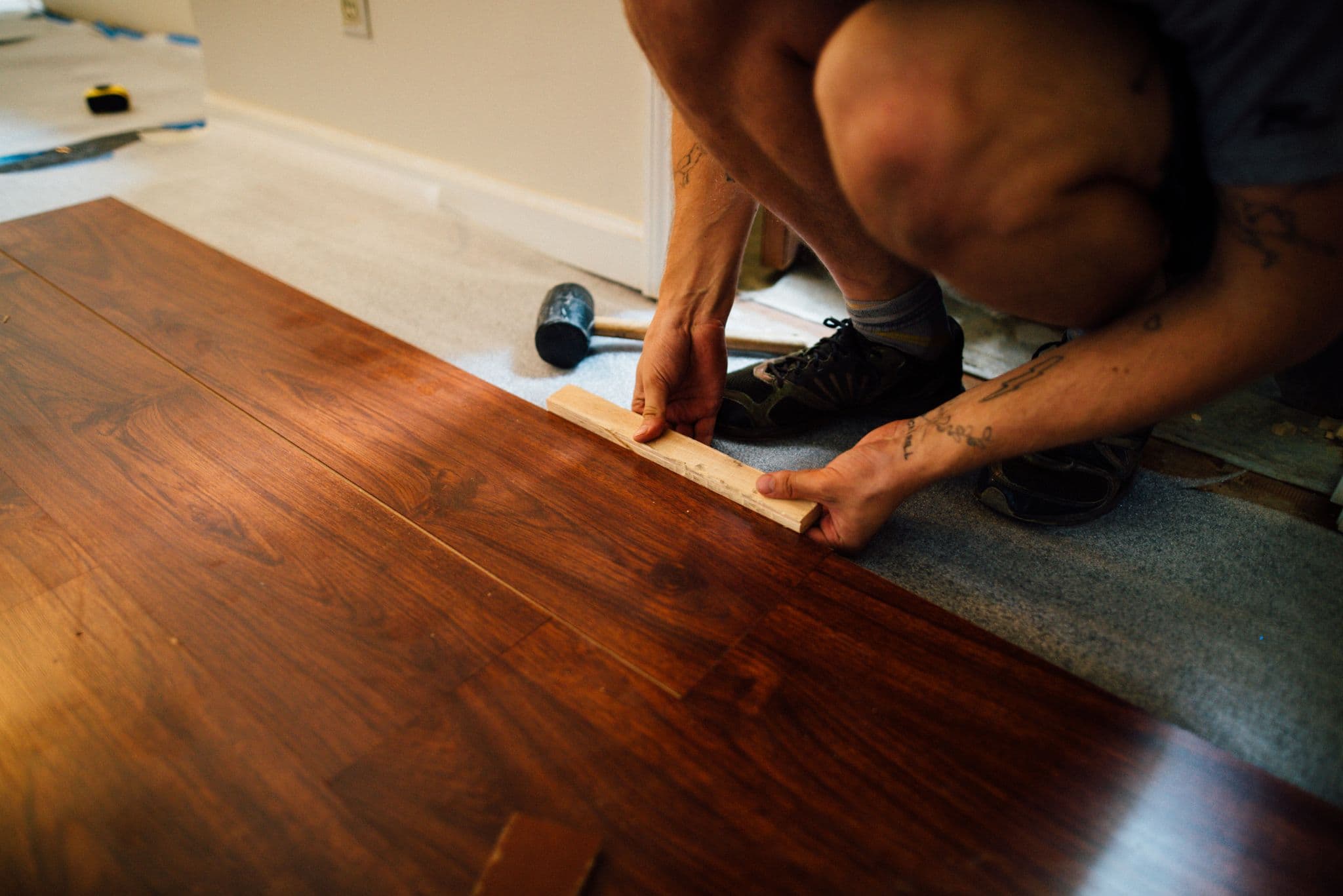
is a floating floor, which means it expands and contracts with temperature and humidity and must be left a gap at every wall to do so. The gap is not a mistake or a sloppy cut, it is what stops the floor lifting in the middle.
That gap is then covered, either by removing and refitting the skirting over the new floor, which looks cleanest, or by running beading along the bottom of the existing skirting, which is quicker and cheaper.